
AKTerm
Synthetic meteorological data for dispersion calculations
- site-specific and verified -
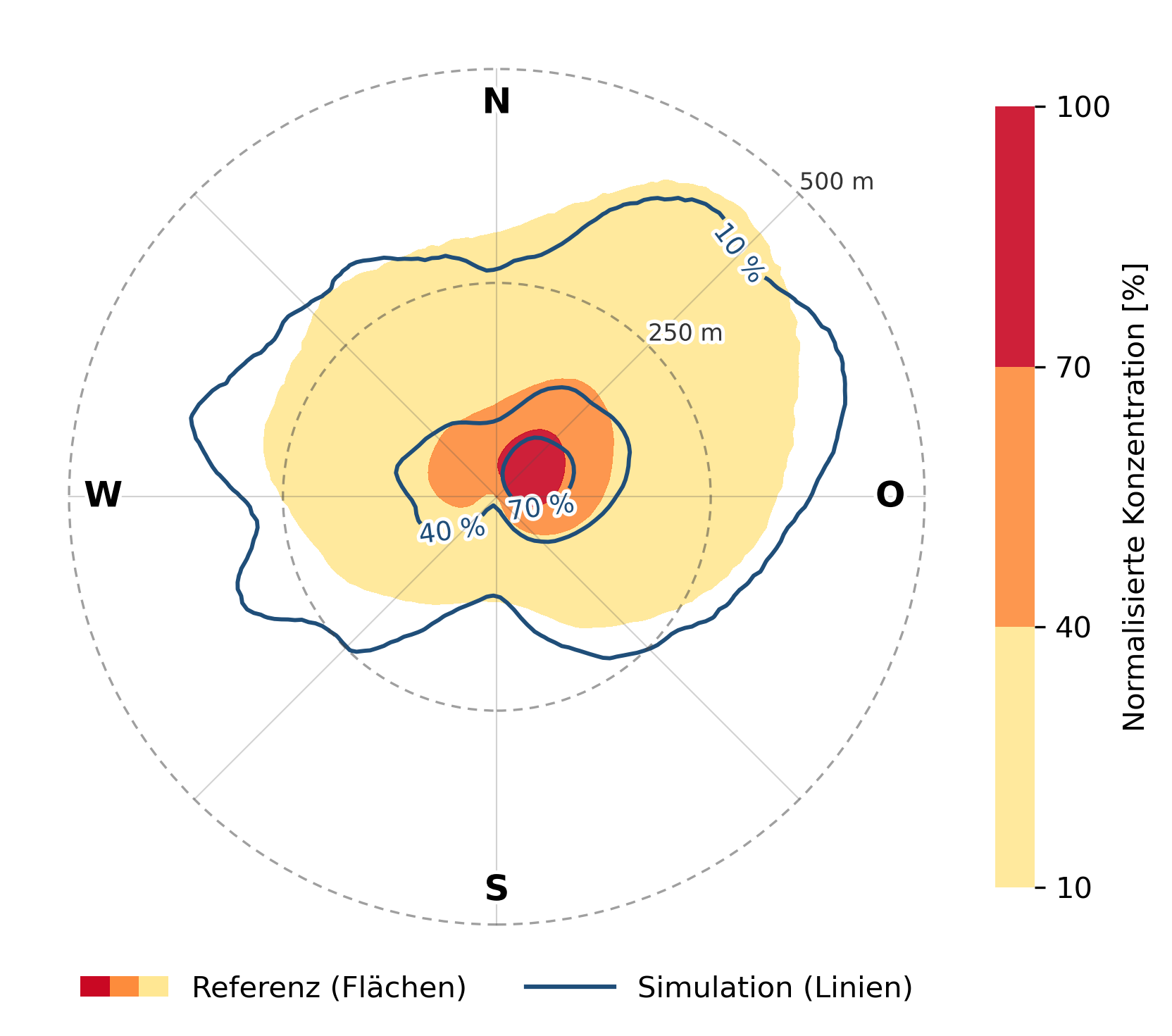
The meteorological input data for dispersion calculations, e.g. with the dispersion model AUSTAL, consist of a one-year time series of wind speed, wind direction and the turbulence state of the atmosphere. The turbulence state is described either by the stability class according to Klug/Manier or by the Monin-Obukhov length. According to TA Luft 2021, data from a meteorological station with proof of representativeness or synthetic data are to be used. The problems of station data, particularly in complex terrain, are well known. Klug/Manier stability classes describe the turbulence state only imprecisely, and the representativeness of the wind data often cannot be ensured even by a transferability assessment.
The anemos wind atlas for Germany provides synthetic data that are consistent over more than two decades, verified and site-specific. The wind atlas was developed with the support of the Federal Ministry for Economic Affairs and Energy (BMWI), the Federal Ministry for the Environment, Nature Conservation and Nuclear Safety (BMU), represented by the German Environment Agency (UBA), and with funding from the State of Lower Saxony (N-Bank). Advantages of the synthetic data:
- The wind atlas time series include, among others, the parameters wind speed, wind direction and Monin-Obukhov length at a temporal resolution of ten minutes. A conversion into stability classes is possible, but not strictly required for calculations with AUSTAL.
- The time series have been consistent and gap-free since 1997 and are continuously extended, so that the derivation of a “representative year” according to VDI 3783 Part 20 always takes the current reference period into account.
- The wind speed is optimized by comparison with near-surface measurements and adapted precisely to the site. The wind field above 40 m was verified by comparison with more than 100 measurements on tall masts and calibrated using optimization methods.
- A transferability assessment is not required.
- A site-specific AKTerm (dispersion class time series) with synthetic data can be generated within a few minutes via the online portal awis.
Your contact person

Martin Schneider
Managing director
Tel.: +49 (0)4131 8308 - 0
martin.schneider@anemos.de
 This product is available in our webtool awis