
Determination of site quality after commissioning (TR 10)

The site quality of a wind turbine (wtg) determines the amount of compensation a wind turbine
gets, if it is promoted under the Renewable Energy Sources Act (EEG).
The ratio between site specific energy yield and reference energy yield is called site
quality. While the reference energy yield is fixed, the site energy yield can change during
the operating time of a wind turbine.
Since the introduction of the tendering procedure and the single-staged reference energy
yield procedure with the EEG 2017, the site energy yield must be redetermined after 5, 10 and
15 years of operation. The remuneration can then be adjusted on the basis of the newly
determined site energy yield. This can also lead to retroactive back payments or refunds if
the site quality changes by more than 2 %.
According to the EEG 2017 only accredited testing laboratories are permitted to determine the
site quality after commissioning. A requirement for accreditation is the regular successful
participation in round robin tests of the Fördergesellschaft Windenergie und andere
Dezentrale Energien (FGW e.V.).
anemos is accredited for the determination of site quality after commissioning, as well as
for the determination of site quality for commissioning (see
Certificate of participation in the TR 10 round robin test Rev. 2.0). On the basis of this accreditation, anemos is authorized to issue corresponding test
certificates that can be presented to the grid operator.
Our services over the operating life
-
Commissioning
Quick check of the data basisA few weeks to no later than 1–2 months after commissioning, we check whether all data required by TR 10 are available.
-
From 1 year of operation
Forecast of site qualityBased on at least one year of SCADA data: shows early on whether repayments or additional payments are likely. Can be repeated at any time.
-
After 5 years
Determination of site quality (TR 10)Accredited assessment based on the operating data of the first five years, the basis for adjusting the remuneration.
-
After 10 and 15 years
Renewed determination (TR 10)The site quality is determined again; a forecast is possible at any time in between.
Determination of site quality after commissioning (TR 10)
The site quality must be determined after 5, 10 and 15 years for wind turbines that are
subsidized in accordance with the provisions of EEG 2017 and EEG 2021. The remuneration may be
adjusted on the basis of this calculation. The site quality after commissioning is determined
according to the calculation rules of Technical Guideline 10 (TR 10). Accredited reports on
site quality after commissioning may only be prepared by testing laboratories that have passed
the latest round robin test.
The basis for the calculation is the operating data collected over the past 5 years. Time series recorded
directly by the plant control system (SCADA), plant-specific status messages and other information,
e.g. from operational management, are used here.
Required data are:
- Data from the system control system (SCADA data)
- Certified or project-specific allocation lists
- Status information, operational management information (logbook)
- Technical system documentation
- EinsMan settlements, DV settlements, etc.
- If possible, feed-in meter data or billing code of the energy quantities fed in
- and further information...
Based on this input data, all time steps of the averaging interval of the SCADA data (typically
10 min) are assigned to one of five EEG categories. An availability is calculated on the basis
of this assignment. The site quality is the ratio of site energy yield and reference energy
yield. For each wind turbine type with a specific hub height, the reference energy yield
indicates the calculated amount of electricity that would be generated at a reference site in
five years of operation based on a defined power curve.
Depending on the calculation method used, fictitious energy quantities are then calculated and added
to the actual energy quantities generated. These can be, for example, restrictions in operation due
to more than 60 hours of maintenance per year, times of fault rectification, data gaps or malfunctions.
Restrictions that have already been remunerated elsewhere, for example as part of feed-in management,
are not remunerated again and are therefore added to the actual energy quantities generated.
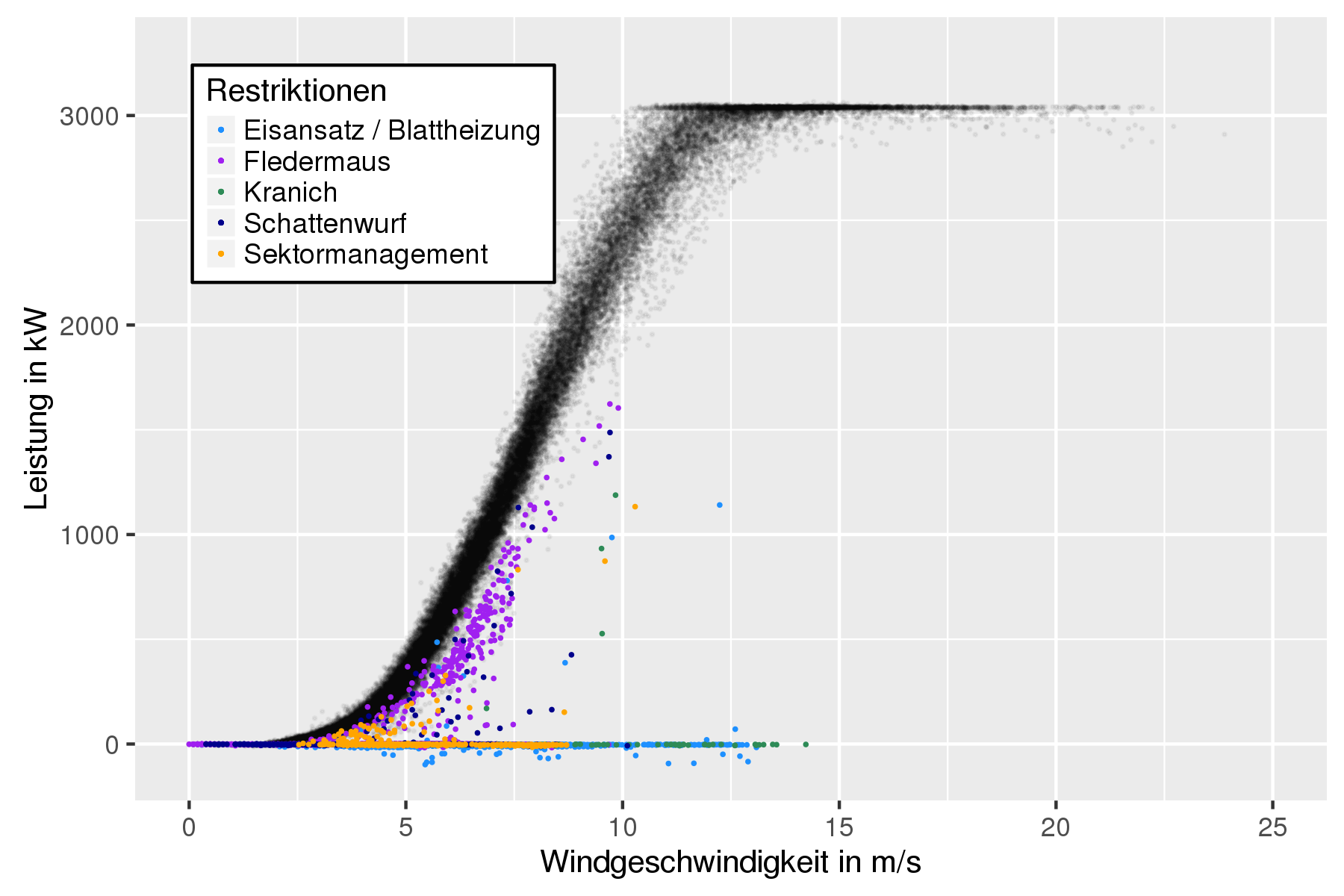
We strongly recommend that you review the data basis in good time. In particular, assigning the time steps to one of the EEG categories can prove to be very complex. It is best to calculate a Forecast of site quality, as we are looking at the entire data basis. For newly commissioned wind turbines, we recommend our brief check of the data basis based on TR 10.
We offer you:
- Many years of experience with SCADA data analysis
- In-house accredited software for determining site quality
- We are always up to date thanks to many years of committee work
- Successful participation in the required proficiency tests
- Possibility of filling data gaps with our high-resolution reanalysis time series (3 km, or site-specific) with a high correlation factor and low RMSE
Forecast of site quality after commissioning
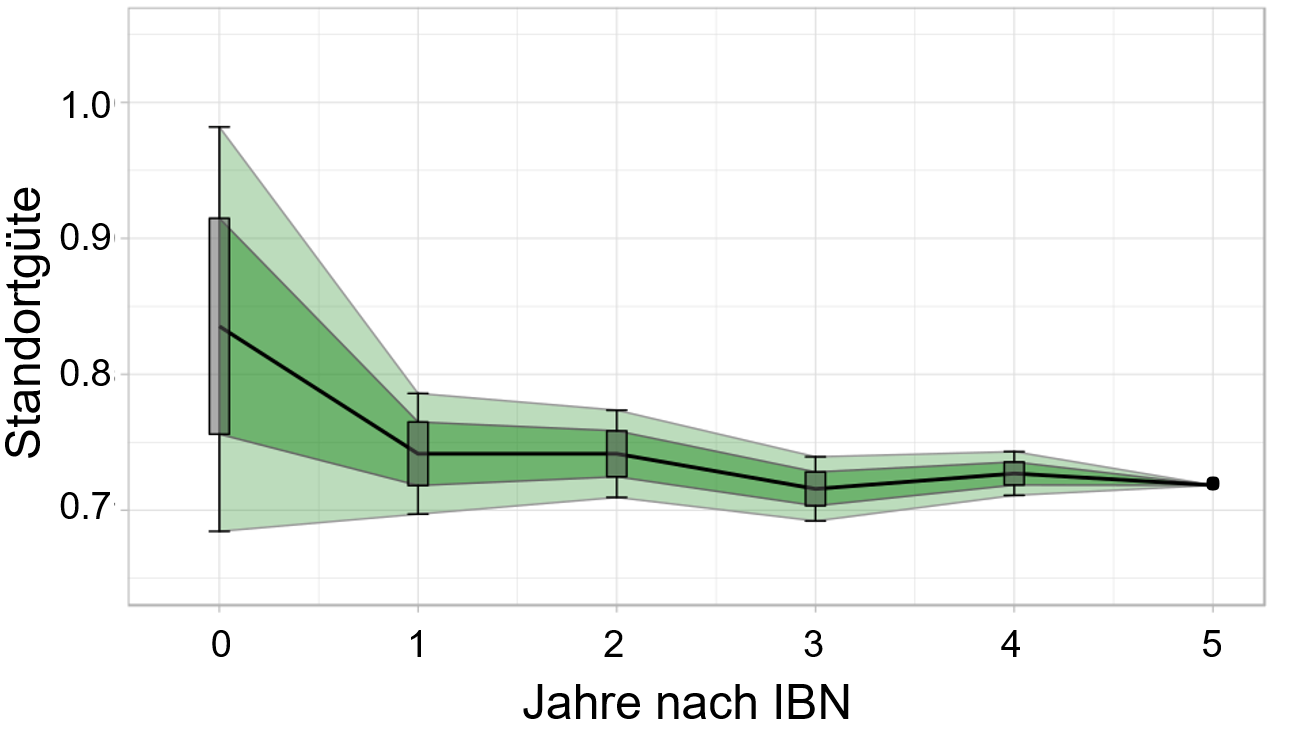
Forecast of site quality after commissioning based on at least one year of SCADA data:
If there is a difference of more than 2 % - points between the site quality after 5 years and the site quality for commissioning, the correction factor for the remuneration is adjusted retroactively. This will result in repayments or refunds.
However, it is particularly important to assess the data and carry out a test calculation at an early stage in order to identify potential problems with the data basis. This largely ensures that there are no surprises when determining the site quality after five years. In addition, there is enough time to collect missing information and we have the opportunity to address any problems that arise in the relevant FGW e.V. expert committees, should this be necessary.
Your advantages in predicting site quality:
- Estimation of the amount of possible repayments or compensation payments
- After just one year of operation of the wind farm, a significantly improved assessment of the site quality is possible
- Forecast based on the long-term yield of the wind farm
- In addition, the typical wind fluctuation range of the remaining period (e.g. 4 years) is determined
Brief review of the data basis for determining site quality
Technical Guideline 10 for the
determination of site quality after commissioning dictates precisely which data must be used to determine the site quality.
Non-compliance with the data basis can lead to long data gaps. We offer you a check of the data basis.
We recommend that you carry out the check a few weeks to 1-2 months after commissioning the WTG at
the latest.
Your advantages with the quick check Data basis:
- Early detection of missing information
- Avoidance of unnecessary allocation to EEG category 2
- Timely identification of problems
- Correct documentation
Talk to us, we will be happy to help you!
Your contact persons

André Glücksmann
Head of IT / Operational Site Quality
Tel.: +49 (0)4131 8308 - 0
andre.gluecksmann@anemos.de

Dr. Gabriel Wolf
Dipl. Meteorologist
Tel.: +49 (0)4131 8308 - 106
gabriel.wolf@anemos.de

Dr. Anna Siems
M.Sc. Marine environmental sciences
Tel.: +49 (0)4131 8308 - 135
anna.siems@anemos.de

Regina Keller
M.Sc. Climate Physics: Meteorology and Physical Oceanography
Tel.: +49 (0)4131 8308 - 148
regina.keller@anemos.de

Dr. Ing. Alexander Clement
M.Sc. Biomedical Engineering
Tel.: +49 (0)4131 8308 - 150
alexander.clement@anemos.de
Your contacts
-

Lasse Blanke
Managing director
Tel.: +49 (0)4131 8308 - 0
lasse.blanke@anemos.de -

Julia Blanke
Dipl. Meteorologist
Tel.: +49 (0)4131 8308 - 120
julia.blanke@anemos.de -
André Glücksmann
Head of IT / Operational Site Quality
Tel.: +49 (0)4131 8308 - 0
andre.gluecksmann@anemos.de -

Martin Schneider
Managing director
Tel.: +49 (0)4131 8308 - 0
martin.schneider@anemos.de -

Krischan Lingel
M.Sc. Environmental engineering
Tel.: +49 (0)4131 8308 - 114
krischan.lingel@anemos.de -

Andree Nather
M.Sc. Meteorology
Tel.: +49 (0)4131 8308 - 113
andree.nather@anemos.de -
Dr. Gabriel Wolf
Dipl. Meteorologist
Tel.: +49 (0)4131 8308 - 106
gabriel.wolf@anemos.de -

Julian Ohl
M.Sc. Environment and Natural Resources
Tel.: +49 (0)4131 8308 - 104
julian.ohl@anemos.de -

Ignacio Martin Santos
M.Sc. Meteorology
Tel.: +49 (0)4131 8308 - 107
ignacio.martin-santos@anemos.de -

Niklas Bauer
B.Sc. Agricultural Science
Tel.: +49 (0)4131 8308 - 116
niklas.bauer@anemos.de -

Dr. Franziska Leverenz
M.Sc. Ocean and Climate Physics
Tel.: +49 (0)4131 8308 - 122
franziska.leverenz@anemos.de -

Dr. Claire Siddiqui
M.Sc. Physical Geography
Tel.: +49 (0)4131 8308 - 123
claire.siddiqui@anemos.de -

Thorben Busch
M.Sc. Meteorology
Tel.: +49 (0)4131 8308 - 117
thorben.busch@anemos.de -

Anna Lensch
M.Sc. Meteorology
Tel.: +49 (0)4131 8308 - 115
anna.lensch@anemos.de -

Philine Podein
M.Sc. Meteorology
Tel.: +49 (0)4131 8308 - 144
philine.podein@anemos.de -

Max Weißenborn
M.Sc. Environmental Sciences
Tel.: +49 (0)4131 8308 - 126
max.weissenborn@anemos.de -
Dr. Anna Siems
M.Sc. Marine environmental sciences
Tel.: +49 (0)4131 8308 - 135
anna.siems@anemos.de -
Regina Keller
M.Sc. Climate Physics: Meteorology and Physical Oceanography
Tel.: +49 (0)4131 8308 - 148
regina.keller@anemos.de -
Dr. Ing. Alexander Clement
M.Sc. Biomedical Engineering
Tel.: +49 (0)4131 8308 - 150
alexander.clement@anemos.de -
anemos head office
General enquiries
Tel.: +49 4131 8308 - 0
kontakt@anemos.de